The Spanish Legion (La Legion Española) is a special unit of the Spanish Army. People often call it the Tercio or the Tercios. For many years, Spain used foreign soldiers in its army. But the modern Spanish Legion was formed in January 1920 as part of Spain’s Army of Africa. At first, it was called the Tercio de Extron jerks (“Tercio of Foreigners”), similar to the French Foreign Legion.
The Legion fought in the Rif War (1921–1926). Although it was meant for foreigners, most of its soldiers were actually Spaniards. Later, the name changed to Tercio de Marr euros and then to the Spanish Legion. The Legion played a major role in the Spanish Civil War on the Nationalist side. After that, it took part in many international missions, including in Yugoslavia, Afghanistan, Iraq, and Lebanon (UNIFIL – Operation Libre Hidalgo).
Current Role and Location
Today, the Spanish Legion mostly takes part in NATO peacekeeping missions. It has around 5,000 soldiers organized into a Brigade with two Tercios (regiments). These are based in Ronda, Málaga, and Viator, Almería. Two more independent Tercios are stationed in the Spanish cities of Ceuta and Melilla in North Africa. The Spanish General Staff directly commands the Legion.
Every year, a company of Legionnaires joins the Holy Week parade in Málaga. They march with the Christ of the Good Death, a statue the Legion adopted as its patron in the 1920s. The Legion also has a veterans’ group in Málaga, and its units take part in Holy Week events all over Spain.
Special Forces of the Spanish Legion
The Spanish Legion has its own special operations unit. It was first called the Bandera de Operations Specials de la Legion (BOEL) or the 19th Legion Special Operations Battalion. Soldiers in this unit volunteer from other Legion Banderas. They get advanced training in diving, mountain warfare, demolitions, and parachuting. They also learn long-range scouting and counter-terrorism. Much of their training happened at Fort Bragg in the USA.
In 2002, the BOEL became the 19th Special Operations Group “Maceral Omega” (GOE-XIX). It moved to Alicante and came under Army Headquarters. Between 2019 and 2020, the battalion returned to the Legion Command. Today, it serves as the Legion’s part of the Army’s Special Operations forces.
Legion Uniforms
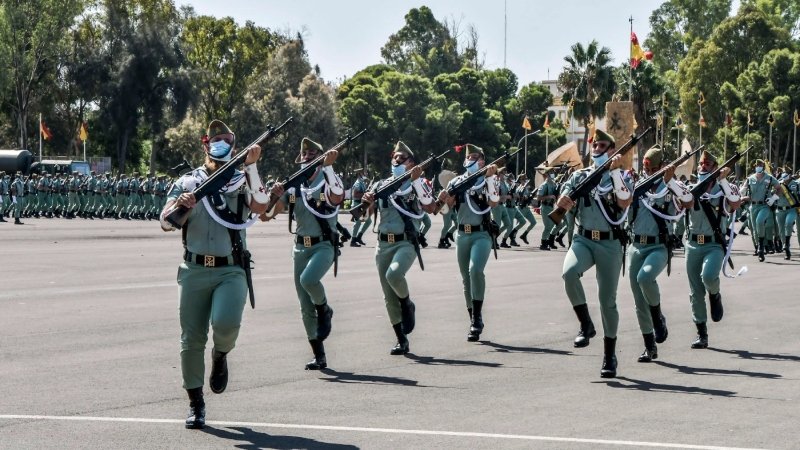
Since its beginning, the Legion has been known for its simple uniforms. This was different from the colorful uniforms worn by other Spanish Army regiments. This simple style was part of the Legion’s focus on being ready for constant action. Today, the Legion uses the same camouflage uniforms for active service as the rest of the Spanish Army.
However, they keep their unique sage-green tropical uniform for semi-formal events and parades. The most recognizable part of the Legion uniform is the khaki “gorilla” cap or “chair.” It has a red tassel and piping. Unlike other military units, Legionnaires are allowed to have beards. They can also wear their uniforms open at the chest.
The ‘Rey Alfonso XIII’ Brigade of the Legion
The event took place on Wednesday at the ‘Álvarez de Sotomayor’ base in Viator (Almeria), headquarters of the ‘Rey Alfonso XIII’ Brigade of the Spanish Foreign Legion. In her speech, the Spanish minister said that “all these hallmark values of our Armed Forces and La Legión in particular will be demonstrated over the course of the upcoming deployments of this unit in Mali and Iraq”.
Furthermore, the minister wished to thank the families for their “dedication, patience, effort and solitude”, and asked them to “support them and to be their strongest rock”. To conclude, María Dolores de Cospedal urged them “to look after yourselves and give your very best”, adding that “we will always feel immensely of you all”.
Among other officials, she was accompanied by the Chief of the Army Staff, Army General Francisco Javier Varela; the Central Government Representative in Andalusia, Antonio Sanz; and the Chief of the ‘Rey Alfonso XIII’ Brigade of the Spanish Foreign Legion, Brigadier General Juan Martín Cabrero.
The event began with the enthronement of the Cristo de la Buena Muerte (Christ of the Good Death), protector of the Spanish Foreign Legion. This was followed by the bestowal of decorations, the naming of Honorary Legionary Knights, the recital of two chapters from the Legionary Creed, a speech by the general and a tribute to those who have laid down their lives for Spain. To conclude the event, the formation sang the anthem of the Spanish Foreign Legion and paraded in front of the attending authorities and invited guests.
The Legion
The Spanish Foreign Legion was raised as a unit of Spanish and foreign volunteers by Royal Decree from King Alfonso XIII on 20 September 1920 to be used as a vanguard force in the Hispano-Moroccan War. At the time, it was called the Tercio de Extranjeros.
For many years, the Spanish Foreign Legion was the only unit of the Spanish Army formed by Spanish and foreign troops. The enlistment of foreigners was suspended in the early 1980s.
Considered the world over as one of the most prestigious military units, the Spanish Foreign Legion has been the first unit used by Spain in overseas operations under the flag of the United Nations and has specialized in stabilization missions in crisis zones.
The Spanish Foreign Legion spearheaded the mission in Bosnia-Herzegovina in 1992 and subsequently the missions in Albania, Kosovo, Macedonia, Iraq on two occasions, Congo and Lebanon, and has also taken part in missions in Afghanistan and Mali.
The Spanish Foreign Legion is currently made up by the ‘Rey Alfonso XIII’ Brigade deployed in Viator and Ronda (Malaga), and the ‘Gran Capitan’ 1st Tercio of the Spanish Foreign Legion and the ‘Duque de Alba’ 2nd Tercio of the Spanish Foreign Legion, based in Melilla and Ceuta, respectively.
The ‘Rey Alfonso XIII’ Brigade of the Legion
The ‘Rey Alfonso XIII’ Brigade (BRILEG) of the Spanish Foreign Legion forms part of the ‘Castilleja’ Division, which is in turn managed by the Spanish Army based in Seville. With over 3,000 legionnaires, it is the largest unit of the Legion.
It was raised in June 1995, when the then Spanish Foreign Legion Command became the BRILEG General Headquarters and relocated from Malaga to its current location at the ‘Olivarez de Sotomayor’ base in Viator (Almeria).
The BRILEG comprises the General Headquarters Banner, the ‘Don Juan de Austria’ 3rd Tercio of the Spanish Foreign Legion, the Field Artillery Group, the Sappers Banner and the Logistics Group, all of which are based in Viator, and the ‘Alejandro Farnesyl’ 4th Tercio of the Legion and the ‘Reyes Catholics’ Cavalry Group, based in Ronda (Malaga).
Slow March
El Novio de la Muerte (Bridegroom of Death) is the unofficial hymn and slow march of the Spanish Legion. It was written in 1921.
For any suggestion, or changes, please contact us, the Kaz Legacy team